
What to Do When a Pipe Leak Appears Without Warning
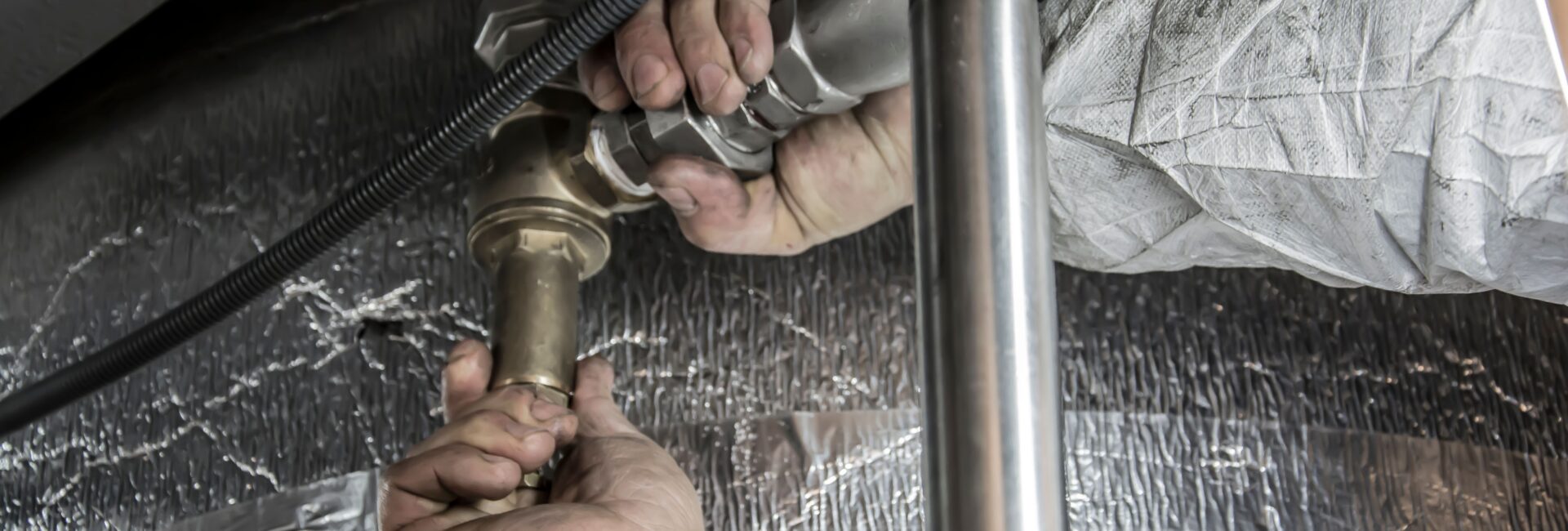
A pipe leak doesn’t give you much warning. One minute everything is fine. Next, you’re looking at water spreading across your floor, dripping through a ceiling, or pooling behind a wall you can’t see into.
When that happens, most homeowners freeze for a second. That’s normal. But what you do in the first few minutes makes a real difference in how much damage you’re dealing with by the time the plumbers arrive.
Here’s a clear, step-by-step guide so you know exactly what to do when it matters most.
The first step is to stop the water flow. Every minute water runs through a broken pipe, the damage grows.
If the leak is from a specific fixture, look for the shutoff valve behind or beneath it and turn it clockwise to close it. If you can’t find a fixture valve, or the leak is somewhere inside a wall or ceiling, go straight to your main shutoff.
In most Brownstown-area homes, the main shutoff is in the basement near the front foundation wall, in a utility room, or where the water line enters the house. Know where yours is before you ever need it. If you don’t know right now, find out today.
Shutting off the main valve stops new water from coming in. But water is still sitting in your pipes. Open a faucet on the lowest level of your home to drain that pressure and reduce how much continues to leak from the break.
Simple step. Worth doing every time.
Grab towels, buckets, or anything absorbent and get them to the area of the leak. If there’s a bubble forming in your ceiling, puncture it in one controlled spot to let it drain rather than spread and collapse. It sounds counterintuitive, but it limits the damage.
Move furniture, rugs, and electronics out of the wet area fast. Water spreads quickly, and what you protect in the first few minutes is what you save.
Take photos and videos before you start cleaning. If you file an insurance claim, that documentation matters. Capture the source of the leak, the visible damage, and all affected areas.
Most homeowners skip this because they want to fix the problem. But you can’t go back and document damage that’s already been cleaned up.
Once you’ve got things under control, call a licensed plumber. Don’t wait to see if it improves on its own. A pipe that’s leaked once is likely to leak again, and the actual cause is rarely as visible as the spot where water first appeared.
The EPA estimates that household leaks waste close to one trillion gallons of water per year nationwide. Many of those start small and become major damage events because they weren’t addressed promptly.
Professional plumbers have the tools to find the exact source of a leak, check whether the surrounding pipe is compromised, and make a repair that holds. Tape and patch kits are temporary measures, not real solutions.
At Ressler & Mateer, we handle plumbing repairs for homeowners across Brownstown, Lancaster, York, and Harrisburg. When you call us, we’ll tell you what we find and what it takes to fix it correctly.
Most pipe leaks aren’t truly random. They typically come from one of these sources:
Knowing the cause helps a plumber determine whether there’s a broader issue in your system, not just the one spot that failed.
If the leak is from your water heater, the situation is a little different. Water heaters fail at the tank, at the pressure relief valve, or at the inlet and outlet connections.
A drip from a fitting can sometimes be repaired. A leaking tank usually means replacement is the right call. We handle water heater repairs and replacements for homeowners throughout the Brownstown area.
A pipe leak is stressful. You don’t have to figure it out alone.
Call Ressler & Mateer at (717) 859-2025 the moment you need a plumber. We serve homeowners throughout Brownstown and surrounding South Central Pennsylvania communities and will give you a straight answer about what needs to be done. Your family’s comfort is our family’s business, and that includes making sure your home stays safe and dry. Visit our website to learn more about the services we offer.
Shut off the water immediately. If the leak is near a fixture, use the local shutoff valve beneath or behind it. If you can’t find that or the leak is behind a wall, go to your main shutoff. Then open a low-level faucet to relieve pressure still in the lines, contain the water with towels or buckets, and call a licensed plumber.
Tape, clamps, and patch kits can temporarily slow a leak but are not permanent repairs. Any time a pipe has actively leaked, the pipe and surrounding connections need to be inspected by a licensed plumber. A professional can identify whether the issue is isolated or part of a larger problem you can’t see.
In most homes in the Brownstown and Lancaster County area, the main shutoff is in the basement near the front foundation wall, in a utility closet, or close to where the water line enters the building. If you’re not sure where yours is, locate it now and label it so you’re not searching during an emergency.
Yes, and faster than most people expect. Water migrates quickly through drywall, insulation, subfloor, and framing. Even a slow, hidden leak can cause significant wood rot, mold growth, and structural weakening over time. That’s why prompt repair matters, not just containment.
Common causes include pipe corrosion from age, frozen pipes that cracked and thawed, fittings that have loosened over time, and water pressure that’s been running too high. In older Lancaster County homes especially, aging galvanized or copper pipes are a frequent culprit.
Condensation forms on the outside of the tank in humid conditions and typically dries quickly. A leak produces steady dripping or pooling that doesn’t stop. Check the pressure relief valve on the side of the unit and the inlet and outlet connections at the top. If water is coming from the bottom of the tank itself, the tank is likely failing and needs to be evaluated for replacement.
Response time depends on the company and demand. Ressler & Mateer serves homeowners throughout Brownstown and the surrounding Lancaster County area. Call us at (717) 859-2025 and we’ll tell you when we can get to you and what to do in the meantime to limit damage.
Russell Ressler III “Rusty” | President & HVAC Estimator, Ressler & Mateer
Brownstown, PA | HVAC and Plumbing Services
Russell Ressler III, known as Rusty, is the President and HVAC Estimator at Ressler & Mateer, where he plays a key role in leading the company’s operations and project planning. With a strong background in estimating and system design, Rusty focuses on delivering accurate assessments and reliable solutions that meet each client’s needs. His approach is centered on precision, efficiency, and maintaining the high standards the company has built over the years.
Rusty takes a hands-on role in both leadership and day-to-day operations, ensuring each project is handled with care and attention to detail. He is committed to clear communication, dependable service, and building long-term relationships based on trust. Through his work at Ressler & Mateer, Rusty continues to support the delivery of consistent, high-quality service to the Brownstown community and surrounding areas.
Share this post:
Trusted Affiliate Partnerships:


